Scope Reference
#include <xo/indentlog/scope.hpp>
Convenience Macros
-
XO_SCOPE(varname, lvl)
Classes
-
class scope_setup
Collect code-location information.
Typically used with logging macros like XO_SCOPE Application code isn’t expected to interact with this class directly
Application code isn’t expected to interact with this class directly
- group scope_setup instance variables
Variables
-
log_level log_level_ = log_level::error
minimum severity level for logging — write messages with severity >= this level
-
function_style style_ = function_style::pretty
FS_Pretty|FS_Streamlined|FS_Simple
-
std::string_view name1_ = "<.name1>"
name extracted from left-hand side of symbol split (e.g. foo in method foo::bar)
-
std::string_view name2_ = "<.name2>"
name extracted from right-hand side of symbol split (e.g. bar in method foo::bar)
-
std::string_view file_ = "<.file>"
captured value of
__FILE__
-
std::uint32_t line_ = 0
captured value of
__LINE__
-
log_level log_level_ = log_level::error
Basic Scope
-
template<typename CharT, typename Traits = std::char_traits<CharT>>
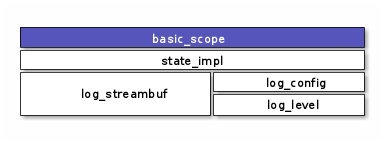
class basic_scope Track nesting level across participating function calls use to drive indentation.
Example:
  using xo::scope;

  void myfunc() {
    XO_SCOPE(log);  //or scope x("myfunc")
    log(a,b,c);
    anotherfunc();
    log(d,e,f);
  }

  void anotherfunc() {
    XO_SCOPE(x); // or scope x("anotherfunc").
    x.log(y);
  }

or:
  void myfunc() {
    bool log_flag = true;
    XO_SCOPE2(log, log_flag);    // create local variable 'log'
    log && log(a,b,c);           // log iff enabled
    log.end_scope();             // optional protection against compiler destroying 'log' early
  }

output like:
   +myfunc:
    a,b,c
    +anotherfunc:
     y
    -anotherfunc:
    d,e,f
   -myfunc:
- Template Parameters:
CharT – character representation type. Usually
charTraits – character traits, usually
std::char_traits<ChartT>